The EU was never just about trade

Eurosceptics often claim to love Europe but hate the European Union, insisting Britain can be part of Europe without EU membership.
While technically true, this perspective misses the EU’s fundamental purpose.
The European Economic Community – later the EU – was founded in the aftermath of the Second World War with a clear goal: to prevent future wars in Europe.
The eleven founders, including Winston Churchill, sought a framework for lasting peace. Europe’s long history of resolving conflicts through war, culminating in two world wars, made this an urgent mission.
The EU was never just an economic alliance. It was always intended as a political and social union, fostering cooperation and coexistence among European nations.
The Treaty of Rome’s objective was ‘ever closer union among the peoples of Europe’ – a vision extending beyond trade.
▪ A United States of Europe
In 1946, just a year after WWII, Churchill delivered his famous Zurich speech:
“We must build a kind of United States of Europe… If at first all the States of Europe are not willing or able to join the Union, we must nevertheless proceed with those who will.”
Three years later, at the Council of Europe in Strasbourg, he reaffirmed this ambition:
“A Europe whose moral design will win the respect of humanity, and whose physical strength will ensure its peaceful future.”
Though Churchill initially did not see Britain as part of this union, he later changed his stance.
▪ “We genuinely wish to join”
The EEC was established in 1957 by France, Italy, West Germany, Belgium, the Netherlands, and Luxembourg – nations that had only recently been at war.
Churchill, addressing Westminster’s Central Hall, welcomed the EEC’s formation and stated, “We genuinely wish to join.”
However, he warned that an exclusive six-nation bloc could divide rather than unite Europe.
-
(Source: Winston S. Churchill: His Complete Speeches Vol. 8 page 8681)
By 1961, Churchill supported Britain’s application to join, and in 1963, he wrote:
“The future of Europe if Britain were excluded is black indeed.”
This is the point many Brexit supporters fail to grasp.
In Britain, we misunderstand the EU’s founding principles, while on the continent, they struggle to understand why we don’t understand.
The EU isn’t just about trade – it’s about peace, stability, and cooperation for the benefit of all its citizens.
Whilst NATO safeguarded against external threats, the EU prevented internal conflicts. For a continent plagued by wars, this was a remarkable achievement.
▪ A Community beyond trade
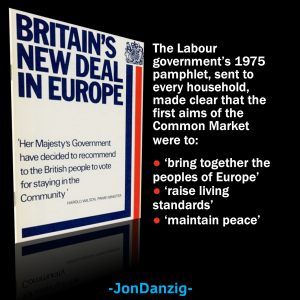
Some claim Britain was misled into believing the ‘Common Market’ was solely about trade. That is untrue. The first referendum debates in 1975, particularly from the NO campaign, centred on political union.
Leaving the EU is about more than ending free and frictionless trade. It means turning our backs on European allies who view the EU as a cherished political project.
Brexit signalled that Britain no longer wished to be part of an extraordinary and unique community – one that, beyond economics, has helped secure peace between member states on a continent once defined by war.

- Join the discussion about this post on Facebook, LinkedIn, YouTube, Instagram, BlueSky
- Remarkable video produced in 1962 that proves the European Community was about much more than just trade.
- Why the UK joined the EU and why we might join again for the same reasons
- Related article: ‘Britain wasn’t misled in 1975’