Brexit: What a difference a day made

In early June 2016 – nine years ago – the UK stood on the edge of a knife.
YouGov’s poll-of-polls showed Remain and Leave running neck and neck ahead of the EU referendum. On 26 May, Remain led with 46% to Leave’s 42%. But by 1 June, the two were tied at 44%.
Even on the eve of voting day, no one could confidently predict the outcome. Some polls gave Leave the edge; others put Remain just ahead.
A day earlier, or a day later, and the outcome could have flipped. That’s how precarious the decision was.
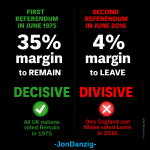
For most of Britain’s 43 years as an EU member, public opinion leaned against Brexit. Ipsos Mori polling in June 2015 showed a record 75% in favour of staying in the EU.
But in the turbulent months before the vote, millions shifted to Leave, swayed by a campaign later revealed to be influenced by Russian disinformation and targeted anti-migrant sentiment.
[Watch theRussianConnection.co.uk]
Yet there was another key factor: turnout. Nearly 13 million eligible voters stayed home. According to the first post-referendum poll (Ipsos/Newsnight, 29 June 2016), these non-voters leaned towards Remain by a 2:1 margin. If they had voted, the result might have swung the other way.
On top of that, millions directly affected by the result were excluded: Britons abroad for over 15 years, and EU citizens living, working, and paying taxes in the UK.
A single day’s vote, on a question so close and unresolved, should never be allowed to lock a country in for generations.
General elections happen every few years. Voters can correct past choices and change governments. But with Brexit, no such democratic correction has been allowed. Since the referendum, the UK has had three general elections. Yet there has been no opportunity to revisit Brexit – no further referendum, no fresh public mandate, no attempt to see whether the public has changed its mind.
That is not how a mature democracy should handle a decision of such scale and permanence. Especially when the original vote was so finely balanced, so easily swayable by time and circumstance, and clearly left the nation divided.
A democratic decision isn’t a one-day contract for eternity. It must allow room to adjust, revisit, and renew based on the evolving will of the people. Britain deserves another say – not because democracy was ignored in 2016, but because true democracy doesn’t stop.