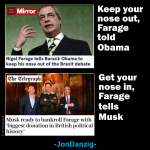
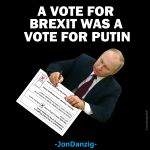
Europe united against Putin and Trump

The grotesque spectacle of President Trump and Vice President J.D. Vance bullying and ambushing Ukraine’s President Volodymyr Zelenskyy in the Oval Office on Friday, 28 February, has shocked Europe.
In response, European leaders have adopted a firmer stance in support of Ukraine. From adversity, unity can emerge.
Only a united Europe can ensure its own peace and security. The days of relying on the United States are over. Trump is aligned with Putin and despises the European Union as much as the Russian president does.
Last week, Trump reignited his attacks on Europe, claiming that the EU was created to “screw” the United States and threatening to impose 25% tariffs against European goods.
Carl Bildt, the former prime minister of Sweden, swiftly countered, posting:
“President Trump has a seriously distorted view of history. Now he claims the EU was set up to ‘screw the United States.’ It was actually set up to prevent war on the European continent.”
Polish Prime Minister Donald Tusk, whose country holds the EU’s rotating presidency, was equally blunt:
“The EU wasn’t formed to screw anyone. Quite the opposite. It was formed to maintain peace, to build respect among our nations, to create free and fair trade, and to strengthen our transatlantic friendship.”
Spanish Prime Minister Pedro Sánchez was even more forceful:
“We will defend our interests when our economies are attacked with tariffs that are completely unjustified and represent a veiled threat to our economic sovereignty. We are committed and prepared to do so.”
Following the Oval Office clash between Trump and Zelenskyy, German Foreign Minister Annalena Baerbock urged Europe to show decisive leadership:
“A ruthless time has begun, in which we must defend the rules-based international order and the strength of law more than ever against the power of the strongest.”
She continued:
“We can never accept a reversal of perpetrator and victim. Such a reversal would mean the end of international law — and with it, the security of most states. And in the long run, it would also be fatal for the future of the United States.”
French President Emmanuel Macron added:
“There is an aggressor: Russia. There is a victim: Ukraine. We were right to help Ukraine and sanction Russia three years ago – and we must keep doing so.”
Dutch Prime Minister Dick Schoof affirmed that the Netherlands supports Ukraine “now more than ever,” stressing:
“We want a lasting peace and an end to the war of aggression started by Russia. For Ukraine and its people, and for Europe.”
European Commission President Ursula von der Leyen and European Council President António Costa assured Zelenskyy in a joint statement that he was “never alone.” They vowed to continue working with Ukraine “for a just and lasting peace.”
And UK Prime Minister Keir Starmer told Zelenskyy in person that he had “full backing across the United Kingdom” during his visit to London on Sunday 2 March for the summit of European leaders to discuss the continent’s defence in the face of Russian aggression.
▪ The threat of division
However, Europe is not as united as it could or should be. Cracks remain.
Hungarian Prime Minister Viktor Orbán and Slovak Prime Minister Robert Fico are openly undermining the EU’s unity on Ukraine, echoing Kremlin talking points.
Orbán has called for the EU to engage in direct ceasefire negotiations with Russia, aligning with Trump’s push for a settlement on Moscow’s terms.
Meanwhile, Slovakia’s Fico has taken an even harder line, refusing financial or military aid to Ukraine and dismissing the West’s “peace through strength” approach as unrealistic.
▪ The EU: A proven peace project
Despite these challenges, the EU remains the most successful peace project in human history.
It is not perfect, but as a model for nations working together democratically, it is unparalleled.
If all European countries were part of the EU, war on the continent could be eliminated. That was the EU’s founding purpose – to prevent conflict among nations that had fought for centuries.
In 2012, the EU was awarded the Nobel Peace Prize for helping transform “most of Europe from a continent of war to a continent of peace.” Yet “most” is not enough.
War still rages in Europe, but not between EU countries. This is the EU’s greatest achievement.
No other political structure in history has succeeded so completely in eliminating war between its member states.
▪ The future of Europe
The answer to Europe’s security is obvious: greater EU integration. More European countries joining the EU means more peace, not less.
The EU is open to any European country that adheres to its core values, as laid out in the Treaty on European Union:
“respect for human dignity, freedom, democracy, equality, the rule of law, and respect for human rights, including the rights of persons belonging to minorities.”
Before joining, a country must prove it has a stable government guaranteeing:
- Democracy and the rule of law
- Human rights and minority protections
- A functioning market economy
- The ability to compete within the EU Single Market
Unlike the Soviet Union or Nazi Germany, which conquered and consumed nations, the EU operates on voluntary participation. Countries join the EU not out of fear of losing their national identity, but because they see it as a pathway to prosperity, security, and peace.
The EU’s motto, “United in Diversity,” reflects this voluntary unity. European nations come together to work for peace and economic strength while retaining their cultures, languages, and traditions.
▪ A united Europe: the only path to peace
If we truly want peace in Europe, we must fully support the EU project.
That means Ukraine must be welcomed as a member. That means the UK should be welcomed back if it chooses to return.
And perhaps one day, even Russia could join – if its can people overthrow dictatorship and embrace democracy, human rights, and the rule of law.
A fragmented Europe is a vulnerable Europe. A united Europe is a peaceful Europe.
The EU is the way forward. For Ukraine, for Europe, for peace.
- Join the discussion about this post on Facebook, LinkedIn, YouTube, Instagram, BlueSky
- Related video: Why Britain joined the EU and why we might join again for the same reasons
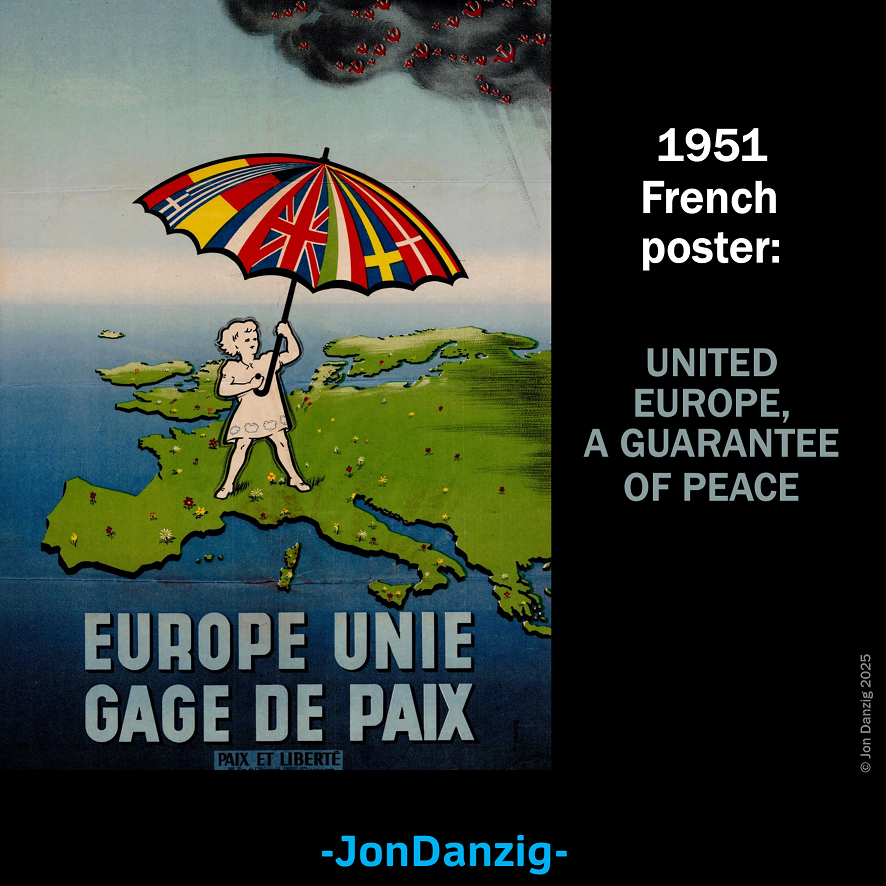
- The French poster from 1951: making a visual argument for western European unity as a bulwark against the Communist threat. The propagana poster features a young woman astride a verdant Europe. Seeking protection from the looming storm clouds of Communism, she holds aloft an umbrella comprising the flags of western European nations. The text says: EUROPE UNIE GAGE DE PAIX (“United Europe, A Guarantee of Peace.”)