Brexit: The advisory referendum that became binding

When Theresa May became Prime Minister in the wake of the EU referendum on 23 June 2016, she was determined to push Brexit through as swiftly as possible.
To do so, she planned to proceed without explicit parliamentary approval, arguing that the referendum had given her an undeniable mandate.
Yet, by law, the referendum was purely advisory – an opinion poll with no legal authority to bind Parliament or the government to a specific course of action.
Nonetheless, the government insisted it could invoke the ancient Royal Prerogative to begin the UK’s withdrawal from the EU without seeking parliamentary consent.
It was Gina Miller who famously challenged this overreach in court, arguing that triggering Brexit without Parliament’s approval was unconstitutional. She won in the High Court, only for the Conservative government to launch an expensive appeal, taking the case all the way to the Supreme Court.
On 24 January 2017, the Supreme Court ruled against the government, affirming that only Parliament had the authority to trigger Article 50 – the EU Treaty mechanism that initiates a member state’s departure. The ruling was clear: the government could not bypass Parliament to begin Brexit, as doing so would alter domestic law and remove rights granted under the European Communities Act 1972.
▪ A Fast-Tracked Brexit Bill
Just two days later, the government rushed through one of the shortest pieces of legislation in British history – the European Union (Notification of Withdrawal) Bill. The entire Bill consisted of just two clauses:
(1) The Prime Minister may notify, under Article 50(2) of the Treaty on European Union, the United Kingdom’s intention to withdraw from the EU.
(2) This section has effect despite any provision made by or under the European Communities Act 1972 or any other enactment.
On the first day of debate, then-Brexit Secretary David Davis rose in Parliament to clarify what the Bill was not about:
“It’s not a bill about whether the UK should leave the European Union or indeed how it should do so. It is simply about Parliament empowering the government to implement a decision already made, a point of no return already passed.”
This assertion was, at best, misleading. Davis claimed that the referendum had already made the decision to leave, implying there was no room for further debate—despite the fact that the referendum was explicitly non-binding.
▪ The Decision That Parliament Never Made
Had Parliament been asked, following the advisory referendum, to vote specifically on whether the UK should leave the EU, it would have necessitated a fully debated bill with impact assessments, committee scrutiny, and expert testimony. The question posed to Parliament should have been the same as that asked of the electorate:
“Should the United Kingdom remain a member of the European Union or leave the European Union?”
Instead, Parliament was merely asked whether it would grant the Prime Minister permission to notify the EU of an intention to leave—a far cry from a decisive, binding vote on Brexit itself.
Crucially, while Parliament debated and voted on the terms of Brexit, it never had a clear, explicit vote on whether the UK should leave in the first place. In effect, the advisory referendum was retroactively transformed into a binding mandate—not by law, but by political manoeuvring and narrative control.
▪ The Consequences of a Hijacked Referendum
In reality, it was Theresa May alone who made the actual decision to leave the EU—a decision subsequently adopted by Boris Johnson, Liz Truss, Rishi Sunak, and now Keir Starmer. The government had taken an advisory poll and, through procedural sleight of hand, converted it into an irreversible decision.
This was despite the fact that:
- The Leave margin was narrow, with neither side securing a majority of the electorate.
- Half the nations of the UK, along with Gibraltar, voted decisively against Brexit.
- Millions of people directly affected by the decision were denied a vote.
- The economic and political benefits claimed by Leave campaigners have since been discredited.
Yet, despite these realities, the government treated the 2016 referendum as an immutable verdict, while Parliament, far from exercising its sovereignty, surrendered its responsibility to scrutinise and decide the country’s future.
▪ The Myth of a ‘Point of No Return’
David Davis was wrong to tell Parliament that the referendum had settled the matter and that a “point of no return” had been reached. The truth is that Parliament never properly debated whether Brexit should proceed. Instead, it was strong-armed into rubber-stamping a course of action framed as a fait accompli.
Today, polling consistently shows that a majority of Britons believe Brexit was a mistake and that, given another chance, they would vote to rejoin the EU. Yet, successive governments continue to insist that a single word – ‘Leave’ – chosen by just 37% of the electorate in a non-binding poll, represents an unalterable destiny.
If democracy is truly about informed decision-making, then the UK must reckon with the fact that it was never given a fair, democratic choice on Brexit – only a manipulated outcome masquerading as the will of the people.
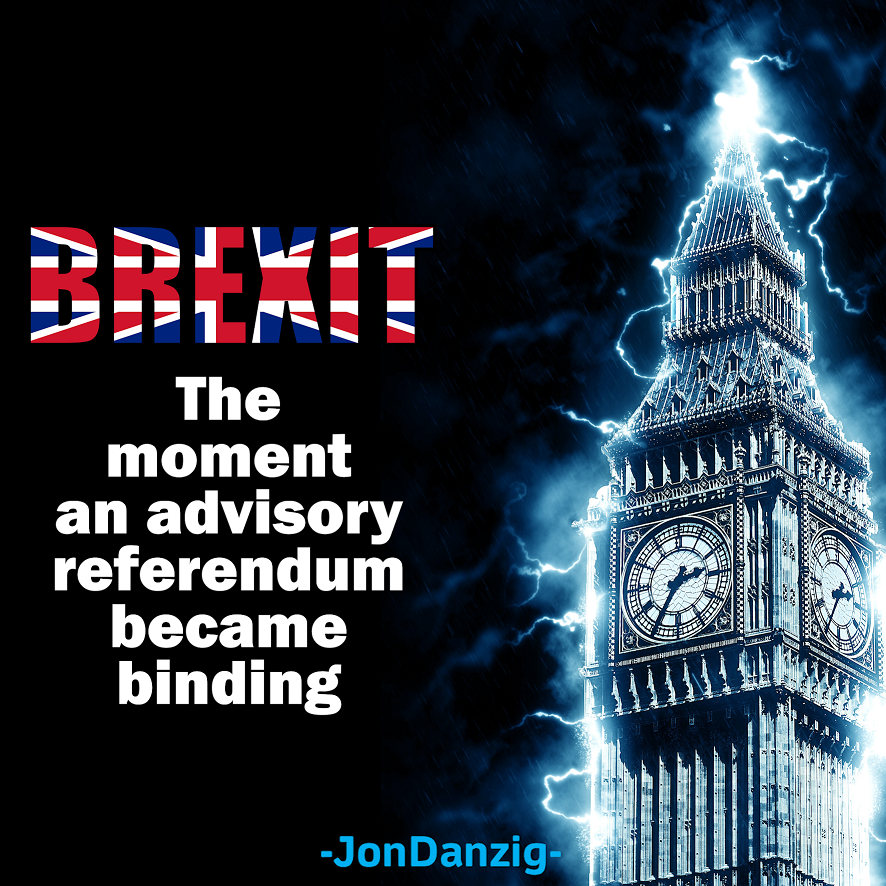
- Related video: The moment in January 2017 that Brexit Secretary, David Davis, turned the advisory referendum into a binding mandate.
- Related article: ‘Who made the Brexit decision?’

- Related video: The moment in January 2017 that Brexit Secretary, David Davis, turned the advisory referendum into a binding mandate.